

"Walk like you belong": The Story of Minnijean Brown-Trickey

Jun 26
4 min read
Authored by Izzy Maundrill
This article is centred around a member of the Little Rock Nine, a group of black teenagers
in 1957 who stood up to Civil inequality. Minnijean Brown-Trickey is often mischaracterized
when this story is told and so this dives deeper into her role and retrospective view on the
powerful and dramatic event.
WHO WERE THE LITTLE ROCK 9? WHAT HAPPENED TO THEM?
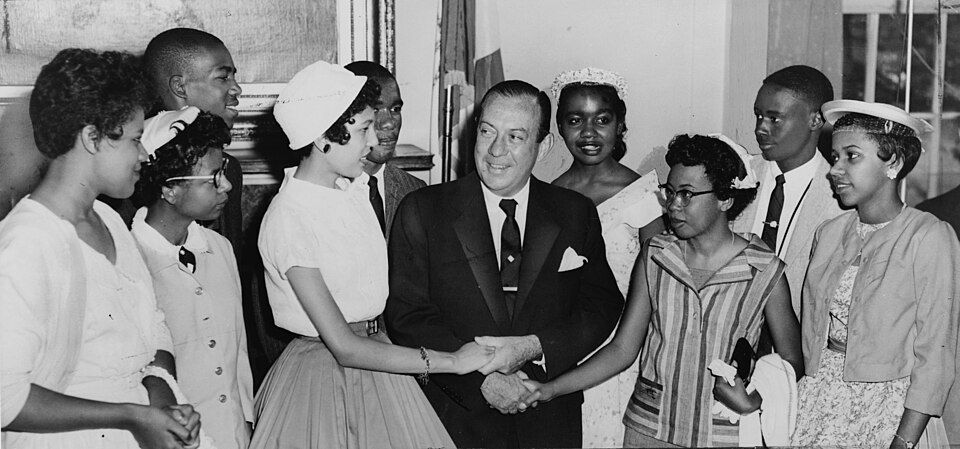
The Little Rock Nine took place in Arkansas following the Supreme Court’s ruling of Brown v. The Board of Education of Topeka, marking a formal beginning of the end of segregation. This ruling made the racial segregation of schools no longer constitutional. Despite this ruling, many Southern states dragged their feet in implementing this law with the Little Rock School Board in Arkansas pledging to voluntarily keep its schools segregated. In 1957 nine black teenagers pushed back against this statement by volunteering to attend Central High and subsequently becoming symbols of the Civil Rights Movement.
The teenagers initially attempted to attend the school on the 4th of September, but were met with the States National Guard at the door blocking them from entering, as well as a hostile mob abusing and harassing them verbally and physically. The governor of Arkansas ruled the Guards’ presence as ‘maintaining the peace and order of the community’. The Little Rock Nine became a national event when President Eisenhower federalised the Arkansas National Guard to protect the nine teenagers. On the 23rd of September the students managed to attend school for three hours as a result of this protection, yet were sent home by the school officials due to them ‘fearing for the lives’ of the volunteers.
Following September 23rd, the Little Rock Nine consistently attended Central High, but not without facing constant and extreme abuse. They had minimal allyship from the white students in the school, with Minnijean even stating that a picture of her and the supportive white girls taken at choir being released was ‘really, really damaging’, as these friendly students were then harassed, further discouraging other students from supporting the Little Rock Nine. I follow Minnijeans story as she was the only one of the group who was expelled from Central High, her feelings towards the experience are shaped by this as she continues to act as a public speaker and activist.
WHAT WAS MINNIJEANS ROLE?

‘didn’t fit anybody’s stereotype of who a young black woman was supposed to be’
At fifteen, Minnijean was expelled in 1958 for calling a girl ‘white trash’ after the girl threw a purse at her filled with locks. Although this abuse was faced by all the volunteers, an interviewer on PBS news in 2008 said that she had heard that Minnijean was especially targeted out of all the Nine and asked her to expand on why she thought this was. Minnijean responded saying that in years following 1958 sociologists interviewed the white girls at Central, with their response being that they ‘hated Minnijean so much.
'She walked the halls of Central like she belonged there’.
Following her expulsion, although moving schools to New York’s New Lincoln School in Manhattan, Minnijean said that she felt ‘guilt over failing the other kids’. New Lincoln School was a private school that prided itself on its progression. Minnijean is most famous for an incident that occurred earlier at Central High where she was being harassed and then accidentally dropped her lunch over a student, Gritchel. As an adult Gritchel described the scene as ‘pandemonium broke loose in the cafeteria at that moment’, with Minnijean being suspended for six days. Gritchel went on to become a lawyer and law professor.
Minnijean looks back upon her time at the school saying that she could not be perfect, even if it meant letting down the people who needed her as a civil rights symbol. She now reflects on the expulsion as, although she has faced ‘character assassination’ both before and as a result of her time in Central, that she also ‘was really too much for them’. Minnijean states that she ‘didn’t fit anybody’s stereotype of who a young black woman was supposed to be’, and this is why she was targeted by the white members of the school. However, this attitude is exactly what she promotes now.
Minnijean utilises her degree in Native Human Services and master’s degree in Social Work to promote diversity education and training, social justice advocacy, and peace-making. She has won many awards such as the Lifetime Achievement, the NAACP Springarn Medal, and the W.E.B. DuBois Institute medal. She now mostly visits schools to further promote change and inspire young people with her story, as well as giving scholarships as part of the Little Rock Nine Foundation. Her central message is to always ‘walk like you belong’… reflecting on her time in Central which resulted in her being targeted for her confident stride and self-worth.
FINAL NOTE FROM THE AUTHOR
The teenage volunteers that came to be known as the Little Rock Nine became cornerstones of the Civil Rights movement. They set a precedent for black children to be able to attend white schools in the South, something that had not been done before despite the Brown v. The Board of Education of Topeka ruling. This represented a newfound act of individual resistance that empowered a communal confidence in those fighting for change during the twentieth century. All the Nine deserve to be recognised but Minnijean’s story of resilience and message of ‘walk like you belong’ is an important one. In retelling Minnijean’s story today, we can seek to understand the transgression and change that she pioneered. We may also recognise how she became a symbol for the voice of women, not only within the sphere of activism, but also in education and politics. Her legacy is enduring and in an age of authoritarian oppression against those who fight for justice, she stands as a symbol of defiance, bravery, and collective determination.


Comments